
Understanding Fellowship Requirements
All levels of Fellowship are achieved by demonstrating how your practice in teaching and/or supporting learning in HE meets the criteria laid out within the Professional Standards Framework (PSF 2023) which consists of two components: Descriptors and Dimensions.
There are different routes to achieve different levels of Fellowship, with a reflective practice route available for all of them and a taught approach available for some groups of staff for Associate Fellowship and Fellowship. You can find out more about routes on the page for each level (accessed from the menu on the left).
Descriptors
The Descriptors are a set of criteria statements. These define the key characteristics of four broad categories of practice as above (D1- D4). Incorporating the Dimensions, each Descriptor identifies the extent of practice required to meet it and recognises the variety of practice and roles undertaken by professionals who teach and/or support learning. Each Descriptor consists of an introduction and a set of three criteria statements, which are detailed in the pages for Associate Fellowship, Fellowship, Senior Fellowship and Principal Fellowship.
Dimensions
The Dimensions of the Framework are arranged as three related sets of five Professional Values, five forms of Core Knowledge and five Areas of Activity. The Dimensions are the same across all levels of Fellowship.
The Dimensions of Practice not only reflect the complexity and multi-faceted nature of the professional role of staff teaching and/or supporting learning but are also broad and flexible enough to accommodate a wide range of practice that is appropriate to different disciplines, contexts and levels of study from level 4 to level 8. It is critical therefore to recognise the importance of context and this is emphasised by the framing of each set of statements with the prefix: “In your context…”.
- Professional Values (V1-5): underpin all forms of Core Knowledge and Areas of Activity. They are the foundation of professional practice.
- Core Knowledge (K1-5): informed by the Professional Values, representing key forms of knowledge required to undertake the Areas of Activity. There are multiple and diverse forms of knowledge which are connected to and shaped by communities and contexts.
- Areas of Activity (A1-5): bring together the Professional Values and forms of Core Knowledge, showing the essential activities that support delivery of effective practice.
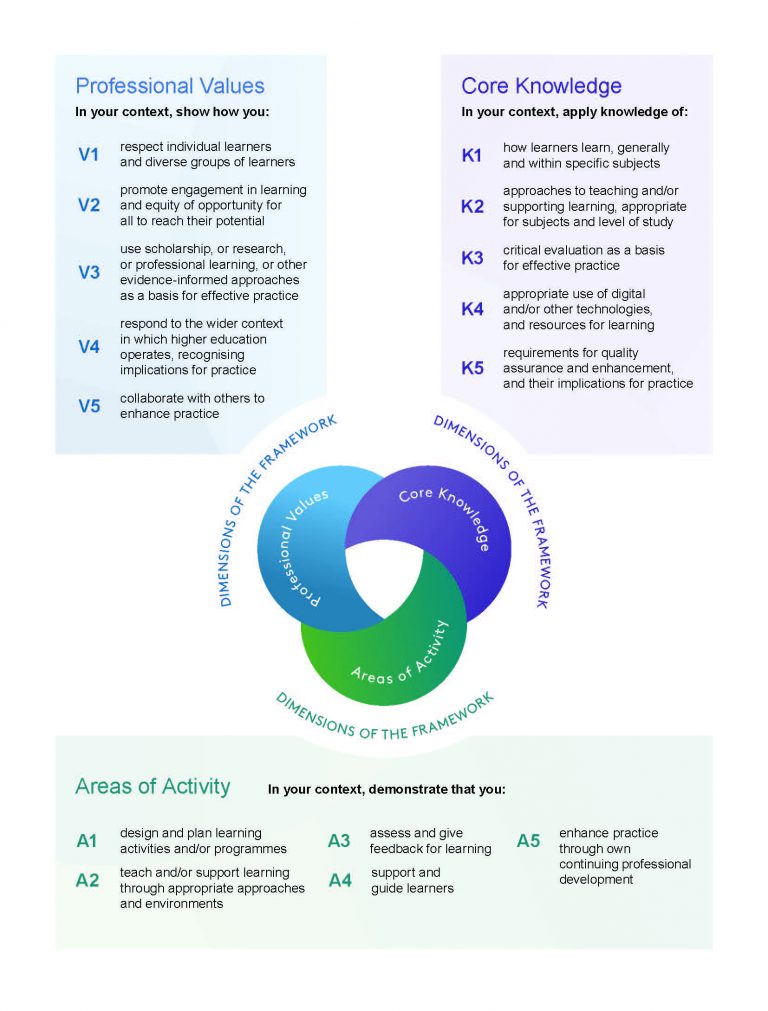
Professional Values
In your context, show how you:
V1 - respect individual learners and diverse groups of learners.
V2 - promote engagement in learning and equity of opportunity for all to reach their potential.
V3 - use scholarship, or research, or professional learning, or other evidence-informed approaches as a basis for effective practice.
V4 - respond to the wider context in which higher education operates, recognising implications for practice.
V5 - collaborate with others to enhance practice.
Core Knowledge
In your context, apply knowledge of:
K1 - how learners learn, generally and within specific subjects.
K2 - approaches to teaching and/or supporting learning, appropriate for subjects and level of study.
K3 - critical evaluation as a basis for effective practice.
K4 - appropriate use of digital and/or other technologies, and resources for learning.
K5 - requirements for quality assurance and enhancement, and their implications for practice.
Areas of Activity
In your context, demonstrate that you:
A1 - design and plan learning activities and/or programmes.
A2 - teach and/or support learning through appropriate approaches and environments.
A3 - assess and give feedback for learning.
A4 - support and guide learners.
A5 - enhance practice through own continuing professional development.
Evidencing the dimensions
Providing evidence of how you meet these dimensions within your practice is a core part of every category of fellowship from D1 – D4 although due to the more limited experience and range of practice expected from those applying for D1, only seven of the dimension statements need be met for this category.
Although these dimensions have been individually identified to articulate them for the Framework, it is not expected that in practice they operate in this discrete way. On the contrary, they overlap and depend on each other, in combination: you will demonstrate a Professional Value whilst undertaking an Activity which requires levels of Core Knowledge to be undertaken successfully.
For example, you may be redesigning a L4 UG module (A1) that incorporates flexibility and choice in the assessment format (V2) due to feedback received from students (K5)
For this reason, it is probably best not to begin with the dimension statements when selecting practice you wish to include in your submission. Instead, select a range of examples of your practice and then map to the dimensions to ascertain which of the statements you are meeting.
The practice used to evidence meeting these dimensions will also vary depending on the category of fellowship applied for.
Those applying for D2 (Fellow) are likely to be providing examples of practice at module or course or programme level and will primarily be engaged in effective and inclusive teaching practice which has a direct impact on students, reflecting their ‘classroom’ involvement.
At D1 (Associate Fellow), however, it may be that the effective practices selected are more session based and drawn from a much narrower range of activity and may be less focussed on a subject or discipline.
At D3 (Senior Fellow), it is recognised that the applicant might no longer be involved in much direct teaching and thus their practice should demonstrate leading or influencing high-quality teaching and learning practice. Their impact on the student experience is likely to be at one remove.
At D4 (Principal Fellow), the expectation is that as highly experienced individuals usually with senior leadership roles, they will often be some time removed from direct teaching and are more likely to be engaged in strategic leadership in a sustained way that affects how other staff meet the dimensions in a more broad and collective way.
Higher Education
All your experience and evidence for meeting all the descriptors must relate to Higher Education provision such as:
- Level 4 or above within the Framework for Higher Education Qualifications (FHEQ) in England, Wales and Northern Ireland, or equivalent
- Level 7 or above within the Scottish Credit and Qualifications Framework (SCQF) in Scotland on the Framework for Qualifications of Higher Education Institutions (FQHEIS) or equivalent
- Level 5 or above of the European Qualifications Framework;
- First cycle or above of the Qualifications Framework in the European Higher Education Area (QF-EHEA)
- Level 5 or above of the Australian Qualifications Framework (AQF) or equivalent
- Level 5 or above of the New Zealand Qualification Framework (NZQF) or equivalent
- Other equivalent higher education frameworks
- Activity focused on supporting learners within a Higher Education context, providing the learner(s) are enrolled on a Higher Education Qualification may also be considered as evidence equivalent to the higher education frameworks above
- Delivery of some non-accredited continuing professional development for academic and learning support staff may also be considered as evidence equivalent to the higher education frameworks.
If you have any questions about eligibility, please contact us at the below email address.